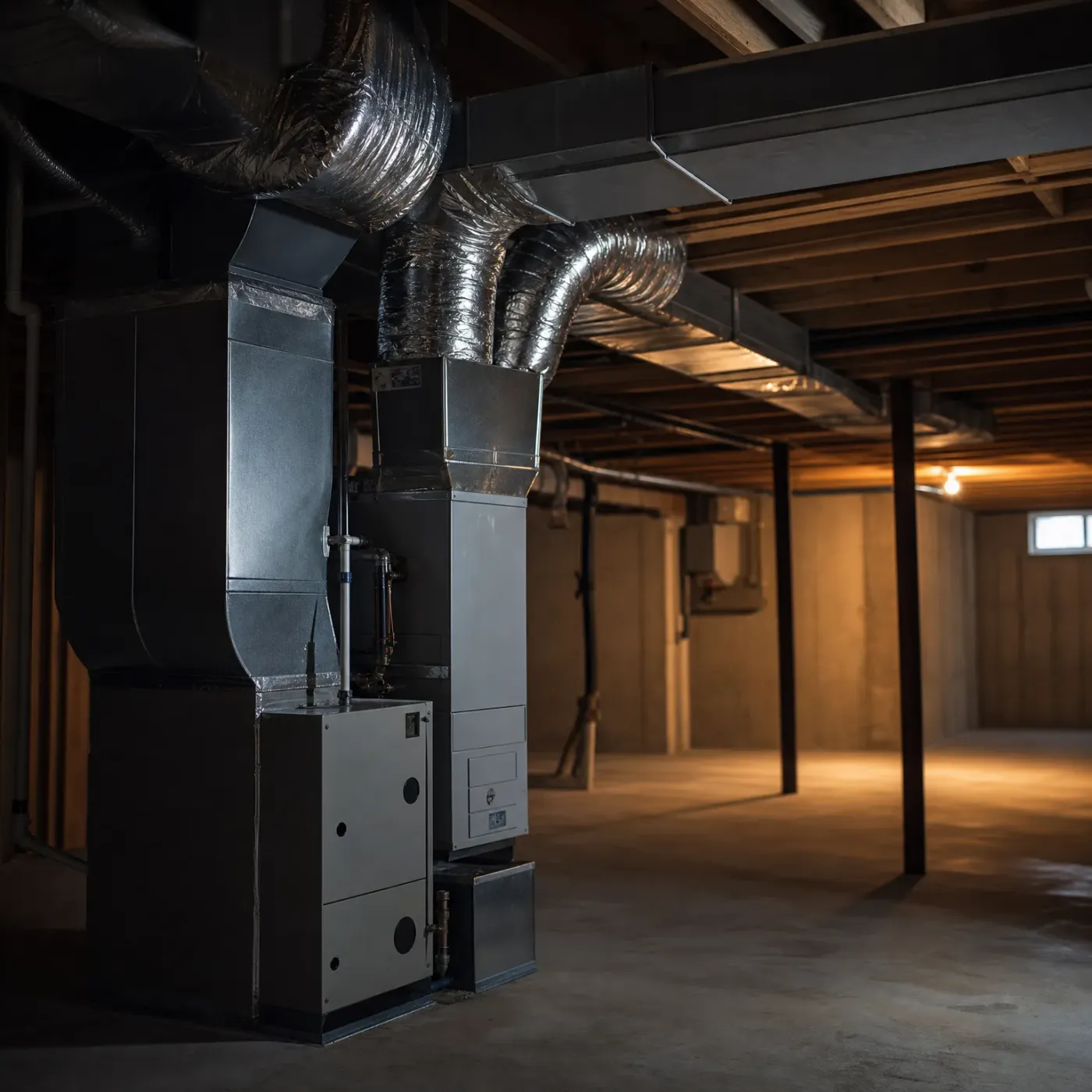



Unfinished basement with concrete floor and walls, exposed wood joists, steel support columns, and two furnace-type units connected to sheet-metal and flexible insulated ducts.

Send one request and you're done looking

Signs of mold in your air ducts in New York

A musty smell when the air handler kicks on, dust that looks darker than usual, a sticky New York summer that never quite lets the ducts dry out. You want to know if that's mold and how it got there. Below are the signs to check before you do anything else. When you're ready, send the form and let a contractor sort out the rest.

Let a pro reach out

A musty smell is the clearest sign, especially when it shows up as soon as the air handler kicks on and fades when it shuts off. Dark specks around the vent covers, or dust that looks gray or black instead of its usual color, often point to the same thing. So can a feeling of damp or heavy air coming through the vents even when the system is cooling fine otherwise. Mold needs moisture to grow, and a New York summer gives it plenty, humid air moving through ductwork that doesn't always dry out between cycles. Condensation can build up in the ducts themselves, especially near the coil, and that moisture sitting against dust and debris is what starts the growth. None of these signs tell you how bad it is or where exactly it's growing. That takes someone looking inside the ducts directly, not just at what's coming out of the vents.

Unfinished basement interior with exposed wooden floor joists, galvanized rectangular and round sheet-metal ducts, a gray furnace unit at left, and a large blank light-colored wall at right.

Why summer here feeds it

Mold needs moisture, and a sticky New York summer gives it plenty. Warm, humid air moves through the ducts all day, and if the system cycles on and off without pulling that moisture out, the inside of the duct stays damp longer than it should. Metal ducts can sweat where they run through unconditioned space. That dampness sitting in a dark duct for weeks is what turns ordinary dust into something growing.

Galvanized sheet metal ductwork with elbows and a vent grille running beneath an exposed wood joist and OSB ceiling, next to a blank white wall.

Where it tends to start

Mold usually shows up first near the evaporator coil and the drain pan, since that's where condensation collects. From there it can spread into the nearest sections of duct, especially any that stay damp instead of drying between cycles. A flexible duct with a low spot or a sag holds water longer than a straight metal run, which gives mold more time to take hold before you'd ever notice a smell.

Does this sound like what's in your house

Check the vents in rooms you use least, a guest room or a finished basement. A ring of dark buildup around the register, or a smell that's stronger there than anywhere else, means air is moving through mold before it reaches you. Run your hand along the inside edge of a vent cover. If it comes away damp or gritty in August, the duct behind it isn't drying between cycles. Anyone in the house with allergies acting up only indoors, or a cough that eases when they leave for the day, is breathing whatever's riding that air. Left alone, it spreads through the duct run and the smell stops going away even with the windows open.

Unfinished basement with bare concrete floor and walls, exposed wood joists, metal ductwork, a furnace unit, steel support posts, and a small window.

Ducts doing their job

This is what a duct system looks like when it's keeping moisture out. The metal is dry to the touch, no dark rings at the seams, no streaking down toward the joists. Air moves through clean, and nothing in the basement feeds mold a reason to start.


Empty basement with bare concrete walls and floor beneath an exposed wood-joist ceiling carrying galvanized sheet-metal ductwork, round ducts and pipes.

Ducts under stress

Here the ducts sit lower, closer to the slab, with less air moving around them. That's where condensation lingers longest and where a musty smell tends to start. If your basement looks like this, the vents feeding off these runs are worth checking first.

Basement ceiling with galvanized sheet-metal ductwork, wooden joists and subfloor, black and white pipes, above a concrete wall and floor.
Before you get your ductwork cleaning
Unfinished basement with bare concrete walls and floor, exposed wood joists, and galvanized sheet-metal HVAC ductwork and pipes running across the ceiling.
After you get your ductwork cleaning

You keep checking the vents yourself, running a flashlight along the seams every few weeks because something seems off and you want to catch it before it spreads to the rest of the system.

A flashlight tells you there's buildup. It doesn't tell you how far it's traveled through the ducts or whether it's already working its way into the insulation around them.

A smiling man in a navy long-sleeve shirt sits at a wooden table in a kitchen and dining area, with a ceramic mug, a potted plant, and a sliding glass door behind him.
A smiling bearded man in a green henley shirt stands at a kitchen island with a gray mug, looking off to the side, with a dining area and shelves blurred behind him.
A smiling bearded man in a navy sweater sits at a white kitchen island with a ceramic mug, with open shelves, potted plants and a range hood behind him.
A smiling man in a dark olive long-sleeve shirt sits in a kitchen beside a counter with a dark mug, with a dining table, sideboard and hallway visible in the blurred background.
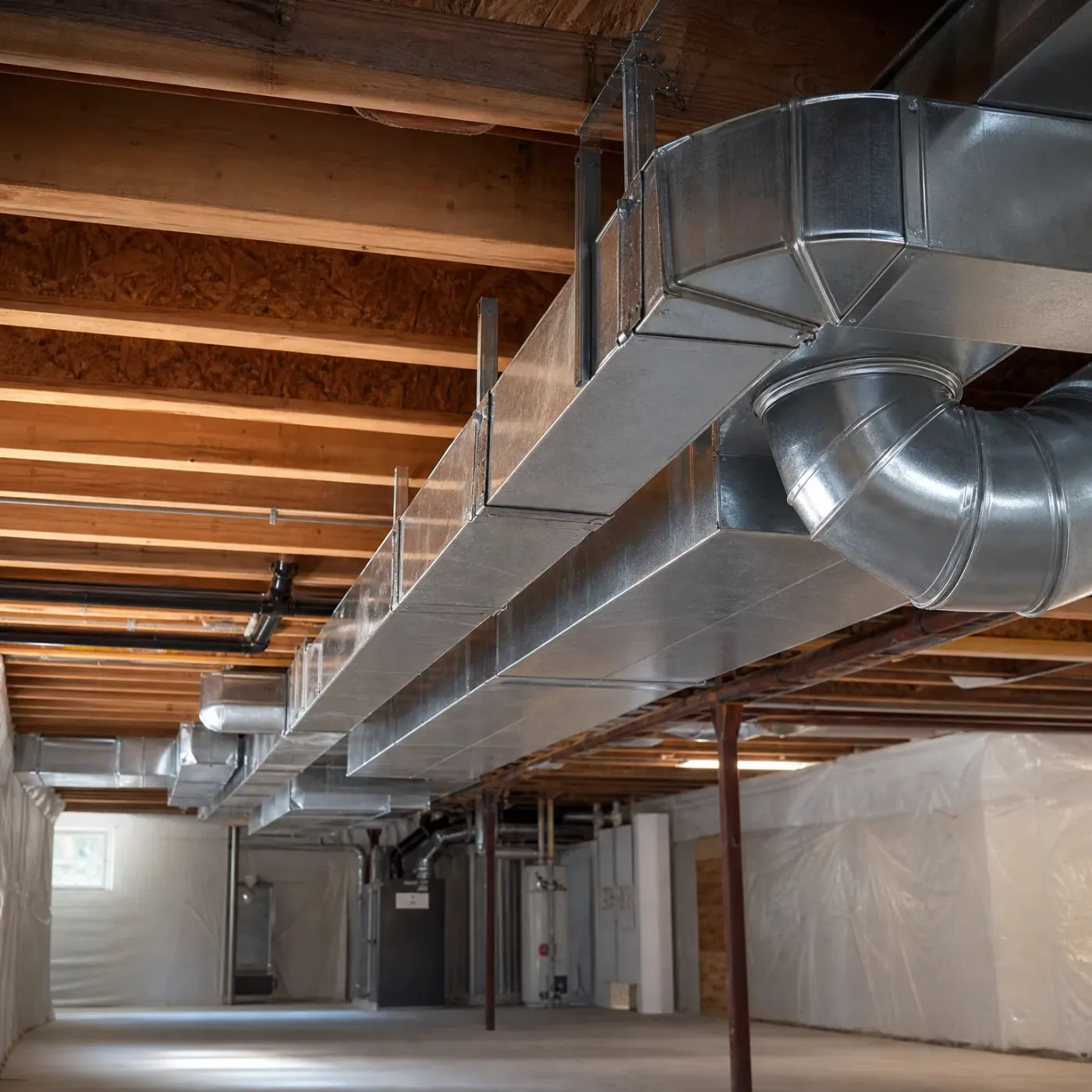
Unfinished basement with galvanized sheet-metal trunk ductwork and round branch ducts suspended beneath wood floor joists, with support posts, plastic sheeting on the walls, and a furnace and water heater along the far wall.

Finding a pro stops being your job

Skip calling around for someone who cleans ducts.

One request and the duct cleaning stops waiting on you.

I'm done searching

Sending the form costs nothing.

Empty unfinished basement with bare concrete floor, insulated walls with vapor barrier between wood studs, exposed wood joists, galvanized sheet-metal ductwork, a recessed light, and a steel support column.
The galvanized ducts here stay dry, the insulation is tight against the studs, and nothing on the joists shows a stain.
Empty basement room with bare concrete walls and floor, exposed wooden floor joists overhead, large galvanized sheet-metal ducts with a vent grille, colored pipes, and a single lit bulb.
Rectangular ducts run close to bare concrete and exposed PEX, with damp basement air settling on the metal with nowhere to go.

How mold moves through the system

  • Mold spores need a surface to land on, and dust buildup inside the duct gives them one, especially where seams aren't sealed tight.
  • The blower pushes conditioned air past every colony in the duct on its way to the room, not just the ones near the vent.
  • Insulated flex duct holds moisture against its inner liner longer than sheet metal, so it can grow mold while the metal duct next to it stays dry.
  • A return duct pulls air from the house, including a damp basement or crawlspace, and carries whatever is in that air back through the system.
  • Mold growing near a seam or a joint usually means air is leaking there, which also means conditioned air is escaping before it reaches the room.
  • Condensation on the evaporator coil is supposed to drain away, but a clogged drain line can send that moisture back into the duct connected to the air handler.

Mold doesn't grow where you'd expect. It needs a surface, moisture, and time, and a duct system gives it all three in places you can't see from the register. Dust collects wherever air slows down, like a seam that isn't sealed tight or a bend in the duct, and that dust is enough of a surface for spores to take hold. Once they do, the blower doesn't stop at the first colony. It pushes air past every patch of growth on its way to the room, picking up whatever's there.

The material matters too. Flex duct has an inner liner that holds onto moisture longer than sheet metal does, so you can have mold growing in a flex run while the metal duct three feet away stays dry. If the system has a return pulling air from a basement or crawlspace, that damp air comes back through the whole system, not just the one room.

A leak at a seam or joint is worth checking for its own reason. Mold near a joint usually means air is escaping there, which means conditioned air isn't making it to the room it was meant for. And if the drain line off the evaporator coil clogs, the condensation that's supposed to run outside backs up into the duct connected to the air handler instead. None of this is visible from where you're standing. It's what a flashlight at the vent can't tell you.

Power costs 26.39 cents per kilowatt-hour statewide

Running the AC all summer against 26.39 cents a kilowatt-hour adds up fast, and a duct system working harder to push air past mold and buildup drives that bill higher still. Clean ducts move air with less strain, which matters more here than in states paying half as much per kilowatt-hour.

EIA-861 2025 statewide residential average

Unfinished basement with bare concrete floor and walls, exposed wood joists, large galvanized sheet-metal ductwork, PVC and copper piping, and a gray furnace unit beside wood stud framing.

Ducts working as they should

The furnace sits dry in the corner, and the metal ductwork running along the joists shows no dark rings or streaking. Air moves through clean sheet metal, and the condensate lines drain the way they're supposed to. Nothing in this basement is giving mold a place to start.

Basement ceiling with large galvanized sheet-metal ductwork, round metal pipes and plumbing lines running beneath wood joists, above a bare concrete wall and floor.

Ducts in trouble

Looking up at the same kind of ductwork, you can see faint water staining on the foundation wall behind it. That dampness doesn't stay on the concrete. It settles on the duct seams and the joists around them, and it gives mold a surface to hold onto that a flashlight from the floor won't always catch.

A smiling man in a dark blue T-shirt sits on a light gray sofa in a living room with a wooden shelf and window behind him, with a laptop edge visible in the foreground.
A bearded man in a plaid flannel shirt stands indoors looking out a frost-covered window, with a steaming dark blue mug on the wooden sill and snow-covered trees outside.
A closed dark laptop and a ceramic mug of coffee on a wooden dining table, with wooden chairs, a dark kitchen cabinet with cutting boards and a potted plant, and a leafy plant by a window in the background.

What you've seen is your answer

A musty smell by the vents, dark dust, a ring of buildup around a register in a room you barely use. If any of that matches your house, your ducts are carrying mold through the air you breathe all summer. That's the sign, and you don't need more than one of them to act on it.

Finding someone to clean a duct system right means calling around, explaining what you found in your basement or your guest room more than once, and sitting with quotes trying to tell which one actually covers the job. Send the form and that part is done. A licensed contractor gets in touch, and from there it's their job to find out how far the mold has spread and clear it, not yours to keep tracking down who can.

A dark ceramic mug on a round wooden table beside a light grey sofa with a woven cushion and knit throw, with a window, potted plant, floor lamp and wooden cabinet blurred in the background.
Dimly lit interior showing galvanized sheet-metal HVAC ductwork running below a wooden joist ceiling above a dark gray wall.

Let someone else find the pro

Answer a few questions about the duct cleaning and skip the search.

Duct and vent cleaningDucts or ventsNew York
Step 1 of 2

What ZIP code is the job in?