Mold in air ducts in Queens, NY

Get matched with a pro who works on ducts in Queens County.

Get matched

Mold in your air ducts usually means moisture got in somewhere and dust gave it something to feed on. Queens summers get humid enough that an oversized or poorly running AC system can leave damp air sitting in the ductwork instead of pulling it out. A leaky duct joint, a clogged drain line, or a return that sweats in July can do the same thing. Once mold takes hold inside the metal or flex duct, it spreads along the dust already coating the inside, and every time the blower kicks on, it pushes spores through the vents and into the rooms you're breathing in. A musty smell when the system starts, dust that looks darker than usual, or anyone in the house with allergies acting up more indoors than outdoors are the signs to watch for. Cleaning the ducts removes what's there now, but whatever let the moisture in has to be fixed too, or it comes back.

Why does mold keep showing up in your ducts?

  • Half the homes here were built by 1953

    Half the homes in Queens County were built in 1953 or earlier, so ductwork put in decades ago has had that much more time to develop leaks, gaps, or damp spots where dust settles and mold takes hold.

  • Heat runs October through April

    Heat runs about seven months a year here, October through April, so warm air moving through old or leaky ducts for most of the year gives any trapped moisture plenty of chances to turn into a mold problem.

  • Cooling runs June through September

    Cooling runs about four months a year, June through September, and those are the months humid air condenses inside ducts that aren't sealed or sized right, feeding mold growth right when you're relying on the system most.

ACS 2020-2024 · NOAA nClimDiv 1991-2020

Musty smell versus visible growth

A musty smell when the system kicks on, with nothing you can see, usually points to mold somewhere in the ductwork rather than in the house itself. Dust in the ducts holds onto moisture and the smell rides the air into every room the system feeds. If you can see dark spots around a vent cover or just inside the duct opening, that is growth you can confirm, not just suspect. Either way the duct run has to be looked at, but visible growth tells a contractor where to start. A smell with no visible source means more of the run needs to be checked before anyone can say where the moisture is getting in.

One vent versus the whole system

Mold around a single vent often comes from something local: a duct that runs through an unheated space, a gap in the insulation around it, or a line too close to a bathroom or kitchen where moisture is heavier. The rest of the system can be clean. Mold showing up at several vents across the house points to the source being upstream, often the coil or the main trunk line where the air handler sits. That's a bigger job, since the moisture is getting into the air before it ever splits off to individual rooms. Knowing which pattern you have before a contractor arrives saves a round of diagnosis.

An older man with gray hair and a beard stands in a dimly lit entryway wearing a dark hooded coat dusted with snow, with a lit table lamp, framed picture, and front door with glass panels behind him.
An older man with gray hair and a beard, wearing a dark snow-dusted jacket and scarf, stands smiling in a dimly lit entry hall with a lamp, wooden front door and staircase behind him.
A gray-haired bearded man in a dark coat with snow flecks on the shoulders stands just inside a dimly lit home entryway, with a lamp, framed pictures, sofa and candle-style lights in the background.
An older man with gray hair and a beard, wearing a dark coat and scarf dusted with snow, stands in a warmly lit home entryway with an arched doorway, lamps, and a living room visible behind him.

Mold needs standing moisture to keep growing, and ductwork can hold that moisture far longer than a wall or a floor dries out, because air moving past wet dust doesn't dry it the way open air does.

That's why mold in ducts tends to come back after a quick wipe-down. The spores stay in the dust packed along the duct walls, and the next humid stretch gives them what they need to start again.

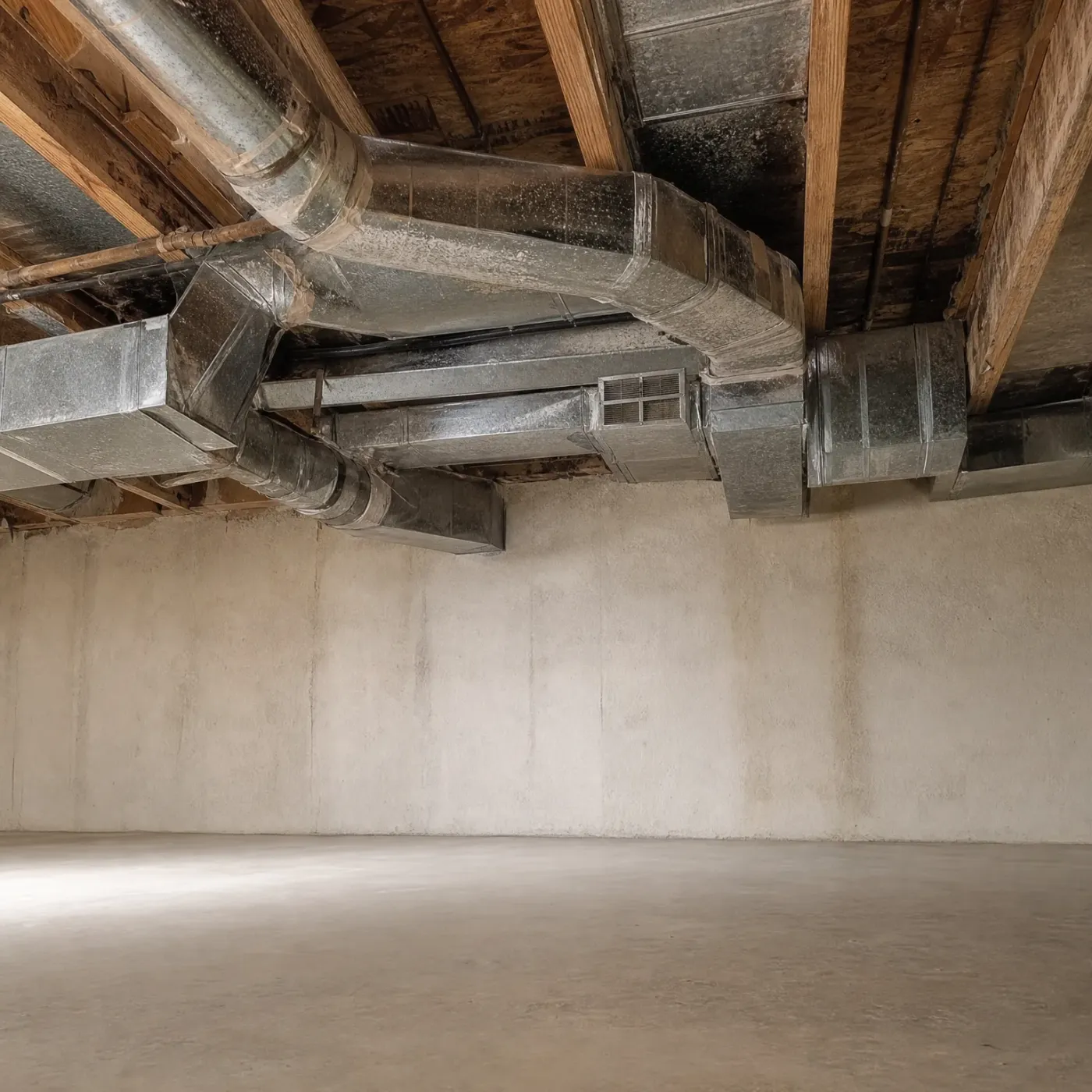
An empty basement room with bare concrete walls and floor, with galvanized sheet-metal HVAC ductwork and a vent grille running along the wooden joist ceiling.
Before you get your ductwork cleaning
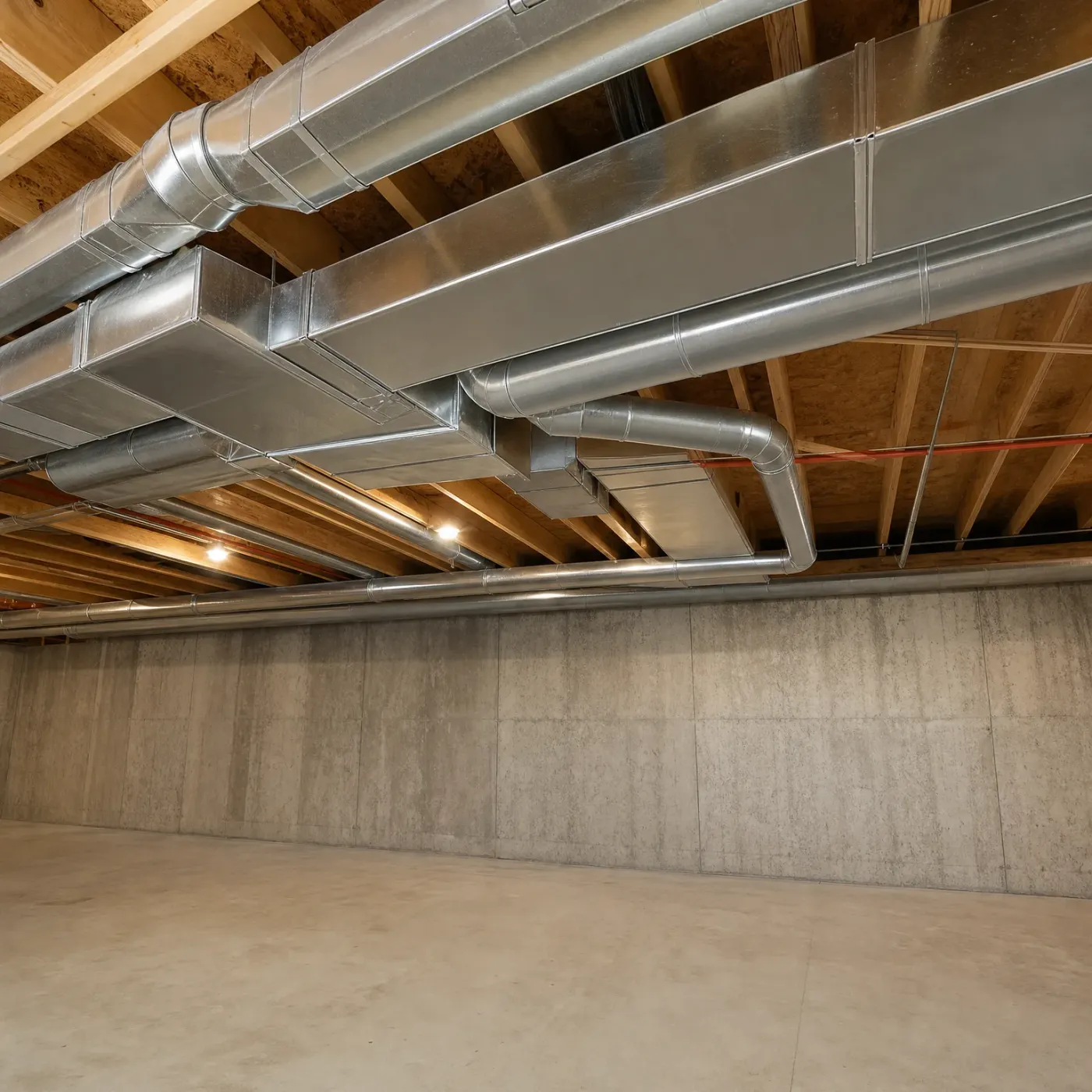
Unfinished basement with bare concrete floor and walls, showing galvanized sheet-metal HVAC ducts, pipes and recessed lights beneath a wood-joist ceiling.
After you get your ductwork cleaning
Unfinished basement with concrete floor and walls, exposed wood joists, galvanized sheet-metal ductwork, a furnace unit, a steel support column, and a small window.

Ductwork running clean

This is what dry ductwork looks like: metal and spiral duct running overhead, furnace tied in against the wall, nothing damp sitting in the joists. Air moves through and out the vents without picking up a musty smell on the way.

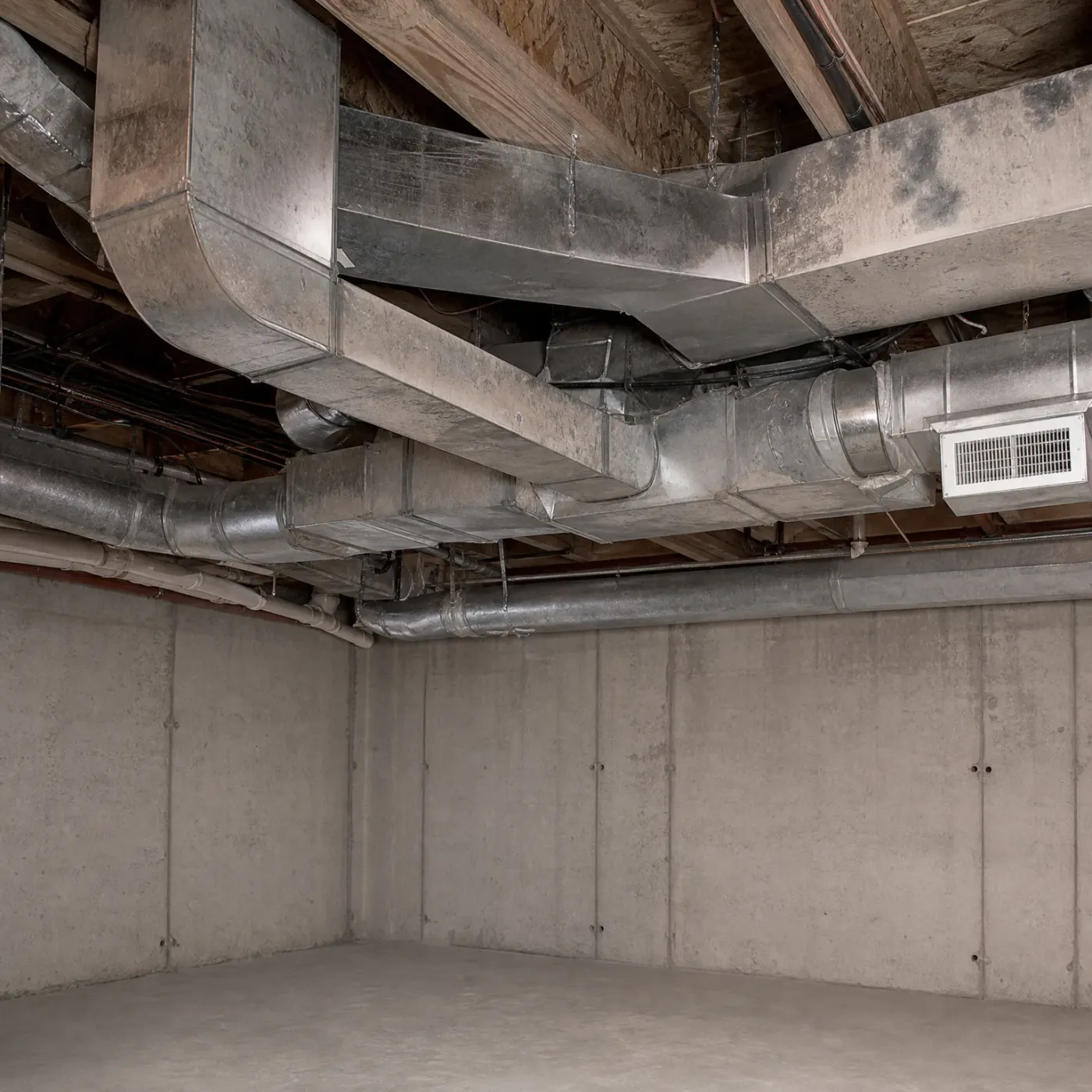
Empty unfinished basement with bare concrete walls and floor, showing exposed wooden joists, galvanized sheet-metal ductwork, pipes, and a white vent grille overhead.

Ductwork holding moisture

Bare ducts like these can trap damp air against the metal and the dust that collects on it, especially where a run sits close to a vent grille with little airflow behind it. That combination is what lets mold take hold and keep coming back.

Clean the ducts or replace them

Clean the ducts

  • A contractor can run a camera through the duct run and show you where the mold is before touching anything.
  • Cleaning deals with what's already growing without tearing into walls or replacing ductwork that's otherwise sound.
  • If the mold is limited to dust buildup and hasn't spread into insulation or the furnace housing, cleaning usually addresses it.
  • You still need the moisture source found and fixed, or mold grows back in the same spots within a season.
  • Cleaning doesn't change a duct system that's leaking or poorly sealed, so the conditions that let mold take hold the first time stay in place.
  • Metal duct that's cleaned well and kept dry afterward can go a long time without mold returning.

Replace the ductwork

  • Flex duct or ductboard that's absorbed moisture over years can hold mold inside the material itself, not just on the surface, where cleaning can't reach it.
  • If sections have sagged, separated, or grown soft with damage, replacing those runs gets rid of material a cleaning crew can't actually clean.
  • New ductwork sealed and sized correctly gives condensation fewer places to collect in the first place.
  • Replacement costs more and takes longer than a cleaning, and it's only called for where the duct material itself is compromised.
  • A contractor who inspects the system can tell you whether it's a cleaning situation or whether sections need to come out.
  • Older duct runs, especially any installed before more recent sealing standards, are more likely to need this than newer sheet metal.
A dim living room corner with a ceiling air vent, a curtained window showing blossoming trees, a table lamp and dark ceramic vessels on a wooden dresser, a potted plant, and a sofa in the foreground.

It is a Saturday afternoon in April and the windows are open for the first time since fall. Light comes across the living room in Queens and catches the ceiling vent grille, where a gray edge of dust has built up along the slats. The coffee table underneath has a thin film on it, the kind you only notice when the sun hits it sideways. You run a finger along the wood and then look back up at the vent. The air coming through smells faintly off, not strong, just enough to make you wonder how long that's been sitting up there and what else is moving through the house with it.


Get matched with a duct system pro in Queens County

Skip searching for someone who cleans ducts in Queens County.

There's no charge for the request.

Empty unfinished basement with bare concrete floor and wall, wood-framed stud walls, exposed joists, galvanized HVAC ducts and pipes overhead, a steel beam and red support column, and a single bare bulb light.
Ductwork like this moves air the way it should, with nothing damp sitting in the joists for dust to hold onto.
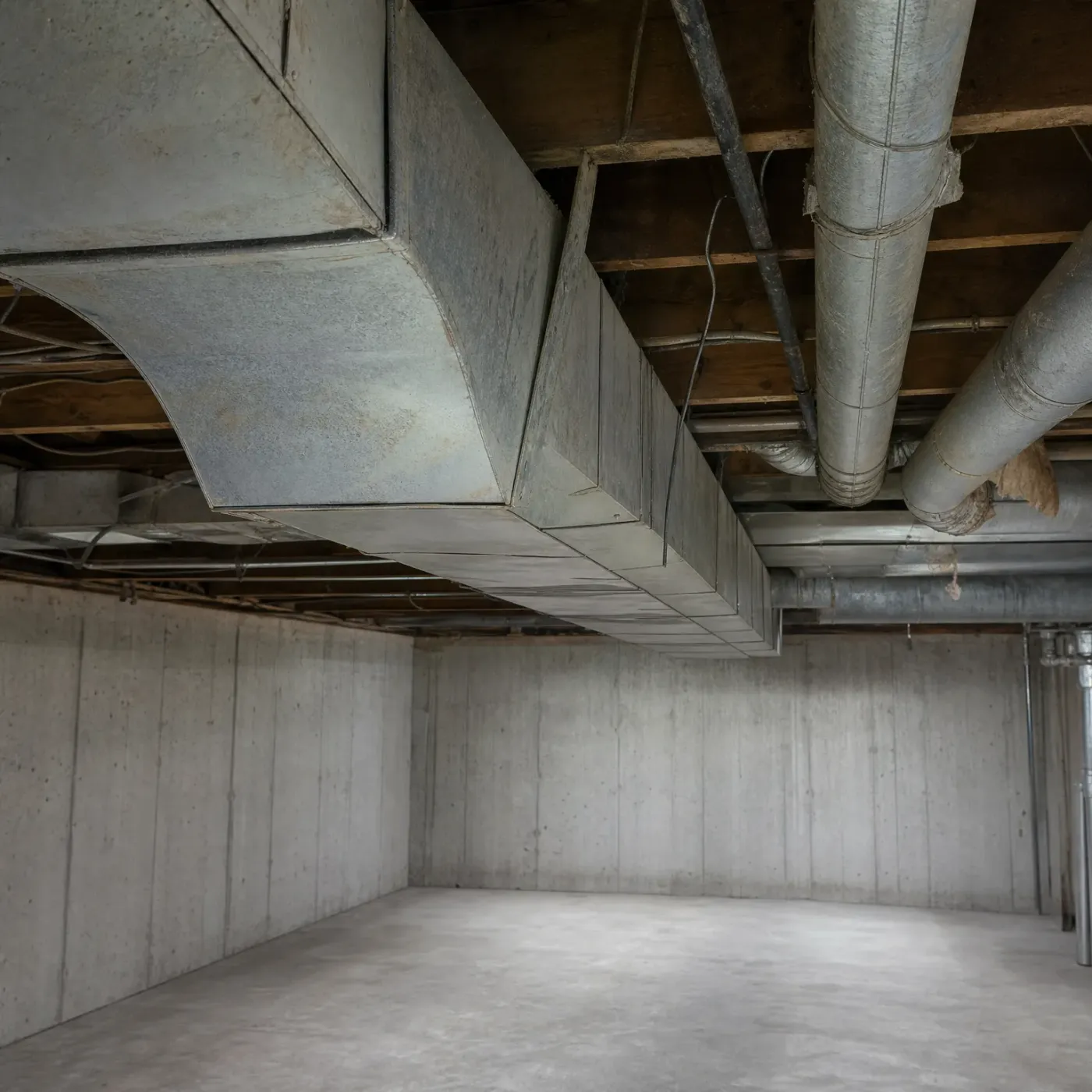
Empty concrete-walled basement with bare floor, showing large galvanized sheet-metal HVAC ducts, insulated pipes, wiring and wooden floor joists overhead.
Ductwork crowded into damp joists like this gives mold a place to settle and keeps feeding it long after the air outside dries out.

How a duct cleaning actually works

  • A duct cleaning job works from the supply side back to the return, so loosened mold spores get pulled toward the vacuum instead of pushed further into the system.
  • The main line connects to a negative air machine that holds the whole system under suction while each branch line gets agitated and cleared.
  • A rotary brush or air whip knocks mold and dust loose from the inside of the metal or flex duct walls without puncturing the material.
  • Every supply and return vent in the house gets opened and brushed out, not just the runs near the unit, since mold spreads wherever damp dust sits.
  • The coil and drain pan get checked too, since a coil running wet behind a closed panel is often what's feeding the mold found further down the line.
  • A contractor usually seals any small gaps found in the ductwork during the same visit, since an open seam is how outside moisture got in to begin with.

A contractor doesn't just stick a hose in the nearest vent and call it done. The job starts at the far end of the supply side and works back toward the return, so anything knocked loose travels toward the vacuum instead of getting pushed deeper into the system. Before any brushing starts, the main line gets connected to a negative air machine that holds the whole duct system under suction, so mold and dust have nowhere to go but out. Inside the ducts, a rotary brush or an air whip does the actual work of breaking mold loose from the metal or flex walls. It's rough enough to clear the buildup but not sharp enough to tear through the material. Every vent in the house gets this treatment, not just the ones in rooms where the smell is strongest, because mold can settle anywhere damp dust collects, including runs far from the furnace or air handler. Partway through, a contractor checks the coil and drain pan, since a coil that's staying wet behind its panel is often the actual source feeding mold further down the line, not just a symptom of it. If the inspection turns up small gaps or seams in the ductwork, those usually get sealed before the contractor leaves, since an open seam is how moisture from outside got in to start the problem. Skipping that step means the same conditions that grew the mold the first time are still there waiting.

Power here costs 35.15 cents per kilowatt-hour

At 35.15 cents per kilowatt-hour, running a fan or dehumidifier longer than it needs to costs you fast. Ducts holding onto damp, moldy dust make your system work harder to push air through, so you end up paying more to move air that still smells musty.

EIA-861 2025

Basement interior showing a furnace with sheet-metal ductwork, a round flue pipe and copper lines running beneath exposed wooden floor joists next to a plain light-colored wall.

Living with it month to month

Mold in the ducts doesn't announce itself with a single bad day. It shows up as a smell that's worse when the AC first kicks on, dust that seems to come back as fast as you wipe it, maybe someone in the house sneezing more at home than anywhere else. None of that forces your hand right away, so it's easy to live with it through another Queens summer and tell yourself it's not that bad yet.

Interior corner of a building with a large blank white wall beside an unfinished ceiling showing wood joists, galvanized sheet-metal ductwork, and white and copper pipes.

Getting it looked at

Finding someone who'll actually run a camera through your ducts and show you what's there, instead of quoting a price over the phone, takes a few calls most people don't have time to make. Once you're matched with a contractor, that part is done. No explaining the musty smell three different times to three different companies, no sorting through quotes that don't say what they're actually cleaning.

What's that smell when the vents kick on

You walk past a vent and catch it before you can place it, a damp, earthy smell that fades a minute later. It's usually strongest right when the system starts up, then seems to disappear once air has been moving a while. Some rooms hold it worse than others, usually whichever ones sit closest to the main duct run. You might also notice dust building back up on sills and surfaces faster than it used to, even right after cleaning. If anyone in the house has allergies or asthma, you may notice their symptoms acting up indoors more than you'd expect, especially right when the heat or AC first comes on.

A woman wrapped in a thick fleece blanket sits on a sofa holding an open book, beside a lit table lamp and a frost-covered dark window.
A smiling older woman with gray shoulder-length hair in a cream cable-knit turtleneck sweater stands behind a wooden board holding a round loaf of bread, in a warmly lit kitchen with a dark window and shelves behind her.
A man with a duffel bag walks up a concrete path toward a white board-and-batten house where a woman stands in the open wooden front door, flanked by potted plants and black lanterns.

Where that leaves you

Mold in your ducts means moisture is getting in somewhere and the dust in there is feeding it. That doesn't clear up on its own, and in a Queens summer, with the AC running most days, it has every chance to come back even after a good cleaning if the moisture source is still there. A camera run through the ducts tells you where it's growing and whether it's just the ductwork or something feeding it from outside.

You don't have to figure out which of those it is before you make a call. A contractor who does this work can look at what your camera run shows, tell you whether cleaning handles it or something else is letting water in, and take it from there. That's one call instead of several, and one visit where someone looks at your actual ducts instead of a list of guesses about what might be wrong.

Interior corner with sheer white curtains at a window, a brown upholstered sofa in the foreground, and a wooden multi-drawer cabinet holding a round ceramic vase with leafy branches.
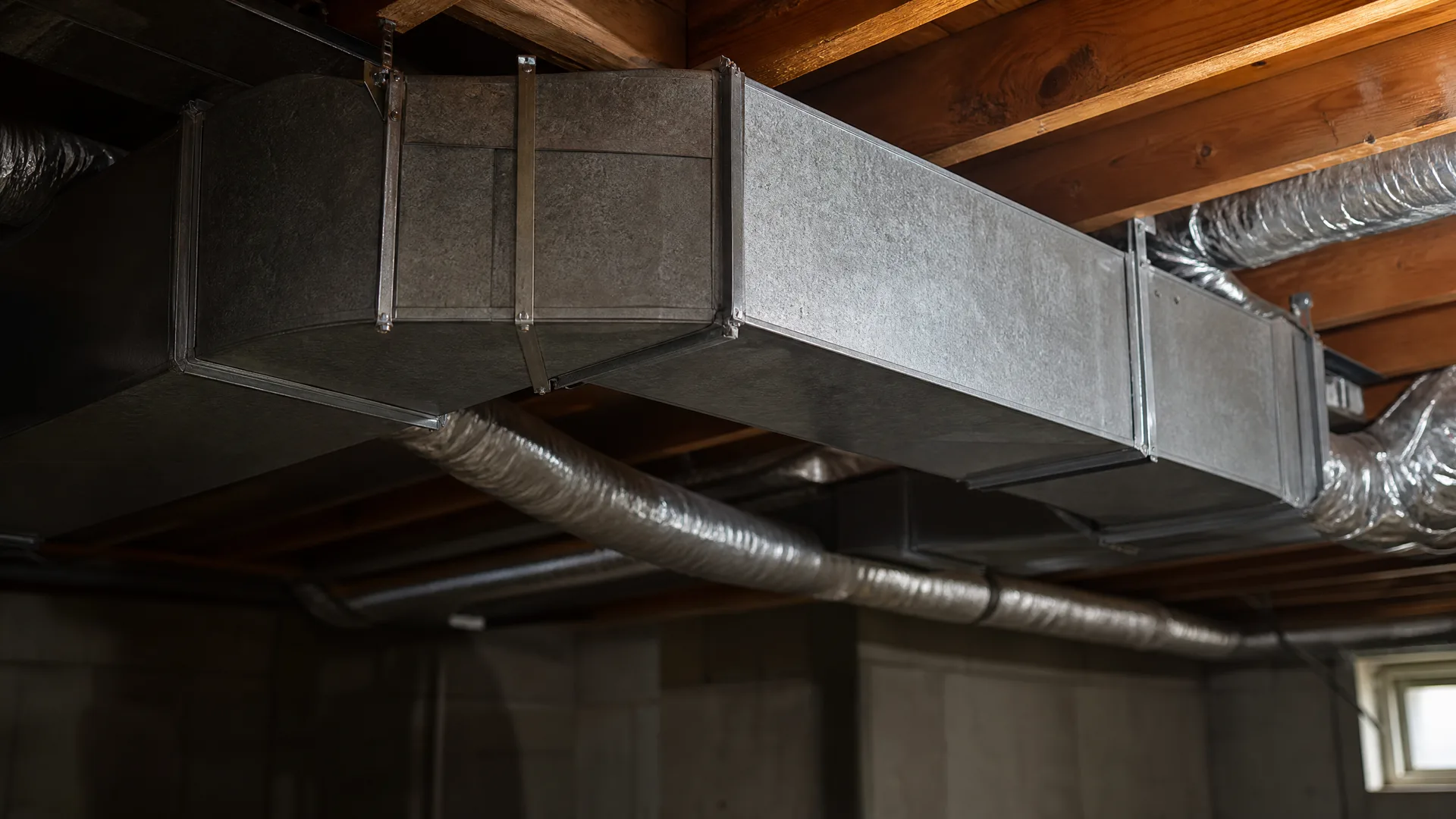
Rectangular sheet-metal HVAC trunk ducting and insulated flexible ducts running along wooden floor joists in an unfinished basement ceiling above concrete block walls.

Find a duct system cleaning pro in Queens County

Duct and vent cleaningDucts or ventsQueens County, NY
Step 1 of 2

What ZIP code is the job in?