








Musty smell from vents in Brooklyn, NY

A galvanized steel round duct section with a 90-degree elbow and a rectangular louvered grille on its straight run, shown against a plain gray background.
I'm done searching

A musty smell from your vents usually means water sitting somewhere in the duct system, and mold or mildew growing on it. Brooklyn summers get humid, and when that damp air moves through ductwork that stays cool from the air conditioner, moisture collects on the inside walls of the ducts instead of drying out. The same thing happens around a clogged condensate drain or a dirty evaporator coil, both common spots for mold to start. Sometimes the smell points to dust and debris that have built up in the ducts over the years, holding moisture long after the rest of the house feels dry. Either way, the smell is a sign that something inside the system is wet when it shouldn't be. It will not go away on its own, and running the AC or furnace more will just keep pushing that air through the house. A full duct cleaning, with attention to the coil and drain line, is what clears it.

Why would mold be growing in your ducts in the first place?

  • Half the homes here were built by 1944

    Half the homes in Kings County were built in 1944 or earlier. Ductwork added to a house that old wasn't always sealed to the standards used today.

  • Heat runs October through April

    Cooling runs June through September here. Four straight months of damp air moving through cold ductwork gives mold plenty of time to take hold.

  • Cooling runs June through September

    Heat runs October through April. Once the system switches over, a duct smell often turns drier or fades, since mold needs the damp to keep growing.

ACS 2020-2024 · NOAA nClimDiv 1991-2020

Where the smell actually starts

  • The evaporator coil runs cold and wet all summer, and dust settling on it gives mold something to feed on.
  • A drain line that's clogged or sloped wrong backs up condensate into the duct system instead of carrying it outside.
  • Ductwork that runs through a damp basement or crawlspace picks up moisture from the outside of the metal or flex before it ever reaches a vent.
  • Flex duct has a fabric-like inner liner that holds onto moisture far longer than the sheet metal trunk lines it connects to.
  • A dirty filter slows airflow enough that the coil stays wetter longer between cycles, giving mold more time to take hold.
  • Once mold is established on an insulated duct or the coil itself, running the system just pushes that smell into every room it feeds.

Start at the coil. Your air conditioner cools air by passing it over a cold coil, and that coil stays wet most of the day all summer. Dust in the airstream lands on that wet surface and mold takes hold there before it shows up anywhere else. The water the coil pulls out of the air is supposed to leave through a drain line. If that line is clogged, or wasn't sloped right when it was run, the condensate backs up instead of draining outside, and it finds its way into the duct system itself. Where the ducts travel matters too. A trunk line or flex run passing through a damp basement or crawlspace picks up moisture on the outside of the material, metal or not, long before any air moves through it. Flex duct holds onto that moisture longer than sheet metal does, because the inner liner is a fabric-like material rather than a hard, smooth surface, and it doesn't dry out the way metal does once the system shuts off. A dirty filter adds to all of this by cutting airflow, which keeps the coil wetter between cycles instead of letting it dry. Once mold has a foothold on the coil or on the inside of a duct, the smell isn't local anymore. Every time the system runs, it carries that air to every room on that duct run, not just the one closest to the problem.

Unfinished basement with bare concrete floor and walls, exposed wood joists, metal ductwork, a furnace unit, steel support posts, and a small window.
Clean, dry ducts move air without carrying any smell along with it.
Empty basement with bare concrete walls and floor beneath an exposed wood-joist ceiling carrying galvanized sheet-metal ductwork, round ducts and pipes.
Moisture sitting in the ducts feeds mold, and every cycle pushes that smell through the house.
A smiling man in a green long-sleeve shirt stands at a dark kitchen counter with a ceramic mug, with wood cabinets, white tile backsplash, and a window and dining table behind him.
A smiling man with wavy dark hair and a beard, wearing a navy sweater, sits at a kitchen counter with a gray mug, with a dining table, potted plant and windows behind him.
A bearded man in a dark green sweater smiles and looks to his right while seated at a white kitchen counter with a gray mug, with windows and greenery behind him.
A smiling man in a dark navy sweater stands in a home interior beside a counter with a white mug, with a kitchen, hallway and potted plant in the background.

Send one request and you're done looking

Describe your ductwork job once, to one pro.

There's no charge for the request.

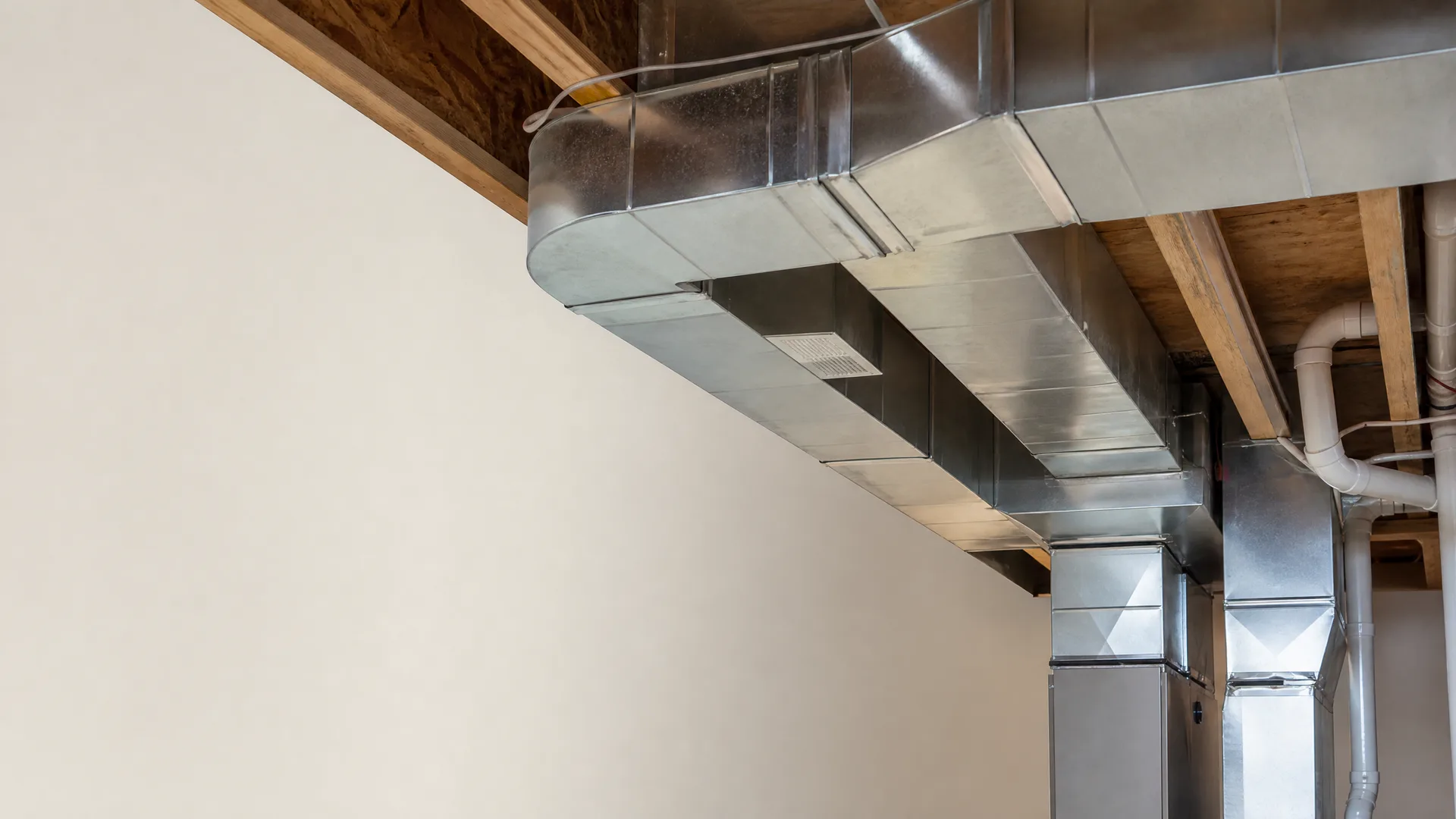
Galvanized sheet metal HVAC ductwork and insulated flexible ducts running along a wooden-joist ceiling beside a plain light-colored wall.

Where the smell starts

The smell doesn't come from the air itself. It comes from mold or mildew sitting on a wet surface somewhere in the system, and the moving air just carries it to every room. That's why it's usually worse right when the AC kicks on. The air passing over that wet spot picks up the smell and pushes it straight through the vents before the duct has a chance to dry out.

Galvanized sheet metal HVAC ductwork running along a wood-joist ceiling beside a plain light-colored wall, with white pipes nearby.

Why it keeps coming back

Running the AC less doesn't fix it, and neither does a new air filter, because the filter sits downstream of where the moisture actually collects. The coil and the duct near it stay damp as long as the system cycles on and off all summer. Until that moisture and whatever is growing on it gets cleaned out, the smell has a steady supply, and it will show up again every time the compressor starts.

What are you noticing when the AC kicks on?

You smell it most in the first few minutes after the AC starts, then it fades. It's strongest in whichever room sits closest to the main trunk line or a return vent. Some houses show other signs too: a vent that sweats in July, a damp patch on the ceiling below a duct run, or air that feels heavier than it should in a room the AC is supposedly cooling. None of this is just unpleasant. Mold sitting in ductwork releases spores into every room the system feeds, and a household with asthma or allergies tends to notice that before anyone else does. Left alone, it doesn't stay the same. The smell tends to get stronger as summer goes on, not weaker.

Unfinished basement with bare concrete walls and floor, exposed wood joists, and galvanized sheet-metal HVAC ductwork and pipes running across the ceiling.

Clean, dry ductwork

This is what the basement should look like. The sheet-metal trunk lines run tight and dry between the joists, no staining, no standing water near the PVC or copper lines. Air moves through here without picking up anything it shouldn't.


Basement ceiling with galvanized sheet-metal ductwork, wooden joists and subfloor, black and white pipes, above a concrete wall and floor.

Ductwork holding moisture

Here the branch lines sit close to the drain pipes and PVC runs, right where condensation collects in summer. Any water that lands on that sheet metal or pools near the junction stays put, and that's where mold gets started.

A wooden table with a closed laptop, a ceramic mug of dark coffee, and a glass vase of eucalyptus stems beside a window, with a dark green kitchen cabinet, wooden counter, potted herb, cutting boards and bowl blurred in the background.

Water sitting in the system is the cause

A musty smell from your vents means mold or mildew is growing somewhere on a wet surface inside the ductwork, and the air moving through is carrying that smell into the rooms. It's not the air itself. It's the coil, the drain line, or a duct run sitting damp long enough for something to grow on it. Clean out that moisture and the smell goes with it.

Right now the job in front of you is finding someone who can get into that ductwork, find where the water is sitting, and clean it properly. That usually means calling a few contractors, explaining the smell and when it happens, waiting on estimates, and sorting through who actually handles duct cleaning versus who just says they do. Send the form on this page and that search is done. A contractor who handles this gets in touch, and from there it's one conversation instead of several.

A gray upholstered sofa with a textured cushion sits beside a dark round side table holding a vase of green foliage, with a table lamp and sheer-curtained window behind.
Dim interior with a dark gray wall, exposed wood joist ceiling, sheet-metal ductwork, conduit, pipes and a sprinkler head.

Finding a pro stops being your job

Skip searching for someone who cleans ducts in Kings County.

Duct and vent cleaningDucts or ventsKings County, NY
Step 1 of 2

What ZIP code is the job in?