Mini Split Installation in Queens, NY
A new system here will heat from October through April and cool from June through September every year. Tell us about the house, and a licensed contractor who covers Queens County will get in touch.
Tell us about the job
It takes about a minute.
Eleven months of work, most of it heating
Queens homes run heat from October through April and switch to cooling from June through September. That is 11 months a year your mini-split is doing one job or the other, with only a few weeks of rest in between.
Winter nights average 28°F, cold enough that a heat pump is working hard to keep up, and summer afternoons average 83°F on the other end. Any unit installed now has to be sized for both. If it was manufactured after January 1, 2023, it also has to meet 14.3 SEER2 for cooling and 7.5 HSPF2 for heating, the federal minimum for this kind of system.
- 7 months
- October through April, your system heats
- 4 months
- June through September, it cools
- 28°F
- the average winter night it heats against
- 83°F
- the average summer afternoon it cools against
NOAA nClimDiv, 1991–2020 normals
- Is a mini split worth it?
- For most homes it is, especially in rooms that a furnace or central system does not reach well, like a converted attic, a garage, or an addition. A mini split heats and cools that one space directly, and with 11 months of the year needing either heat or cooling here, a unit that handles both earns its keep. The best fit is usually a room with no ductwork nearby, since running new ducts costs more than mounting a wall unit. A contractor can look at the specific room and tell you whether it makes sense there.
- How many rooms can a mini split cover?
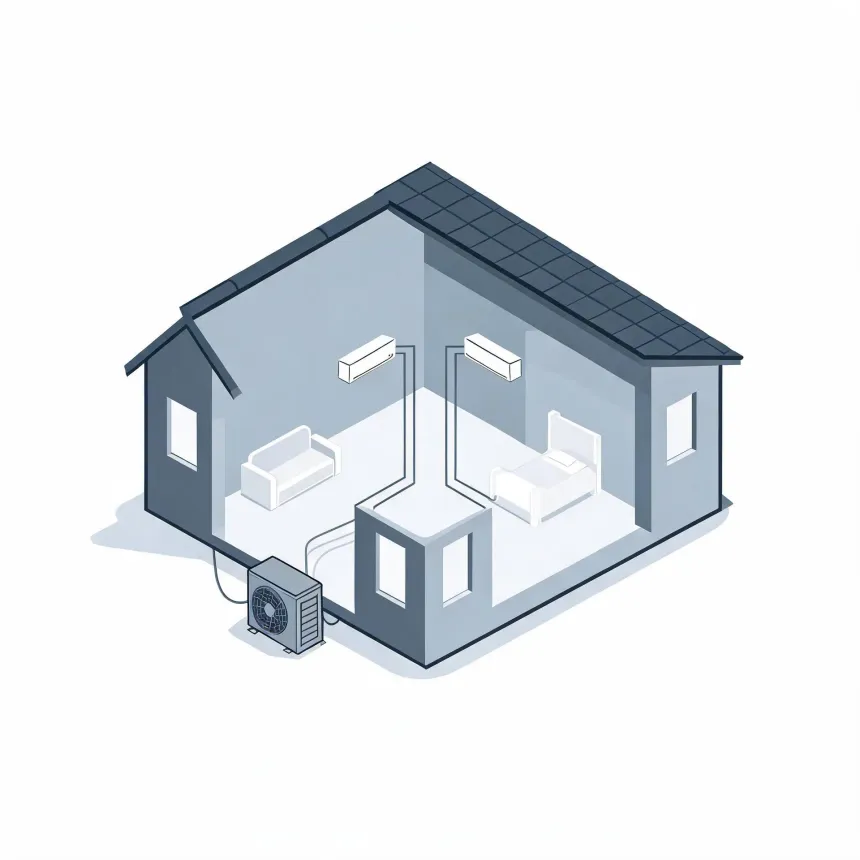
- A single outdoor unit can run one indoor head or several, depending on the system. Each indoor head heats and cools the room it is mounted in, so a home can use one head for just the room that needs help, or several heads on one outdoor unit to cover more of the house. More zones on one outdoor unit means less capacity to split between them, so a contractor sizes the system to the rooms you actually want covered, not just the room count.
- Can a mini split heat a whole house?
- A multi-zone mini split can heat a whole house if there is an indoor head in every room that needs it, but a single head only heats the room it is in and whatever space is open next to it. Winter nights here average 28°F, and at that temperature a mini split has to work harder to keep up, so the system needs to be sized for the coldest nights, not just the mild ones. A contractor can walk the house and figure out how many heads it takes to cover it.