Signs your ducts need cleaning in Manhattan, NY

Your request goes to a New York County pro who takes ductwork jobs.

Get a duct system pro

Dust building up around your vent covers within a week or two of cleaning them is one sign. So is a musty smell when the air handler kicks on, which usually means dust or mold sitting inside the ducts themselves. If anyone in the apartment is sneezing more or their allergies seem worse once the heat or AC has been running a while, that is another. Apartments and townhouses here often share duct runs or have ducts that pass through walls shared with other units, so dust, debris and sometimes pests travel further than in a detached house and build up in bends and joints you cannot see or reach. Visible dust kicked out of the supply vents when the system first turns on, or a layer of dust on furniture that returns fast after you clean, both point the same direction. None of these prove the ducts themselves are the problem rather than the filter, but together they are worth having someone look at.

Galvanized sheet metal HVAC ductwork and round pipes running along an exposed wood-joist basement ceiling beside a plain white wall.

Why vent dust comes back fast

A duct system full of dust doesn't just sit still. Every time the blower turns on, it pushes that dust back through the supply vents and into the apartment. That's why wiping the covers down does nothing for long. The coating comes back because the source is inside the duct run, not on the grille. Gas furnaces here cycle often once it turns cold, and each cycle moves another round of dust through the rooms.

Galvanized sheet metal HVAC ducts and round pipes installed among wooden joists on a ceiling, beside a large blank white wall.

What a musty smell is telling you

Mold needs moisture to grow, and a duct system can hold onto it longer than you'd think, especially after a humid Manhattan summer. If the smell only shows up when the air handler kicks on, the moisture and whatever's feeding on it are sitting somewhere in the ductwork itself, not in the room air. Running the fan without the heat or AC on can help you tell if the smell is coming from the ducts or from somewhere else in the apartment.

How do you know if it's actually the ducts and not something else?

You've noticed dust or a musty smell and you're wondering if cleaning the ducts will actually fix it, or if the real problem is somewhere else, like the air conditioner, a leak, or just the apartment itself. It's a fair question before you go to the trouble of having someone come look at the vents.

Check whether the smell or dust tracks with the blower running, not the room

If the musty smell only shows up when the heat or the air conditioning turns on, that points to the ducts or the coil, not the apartment generally. A smell that's there all the time, blower on or off, is more likely mold somewhere in the unit itself, a bathroom, or a window that doesn't seal well. Same with dust. If one or two rooms get dusty fast while others stay clean, look at what vents feed those rooms. If every vent cover in the apartment is doing it, and it keeps coming back no matter how often you wipe them down, that's the ducts pushing it back out every time the system runs.

An older man with gray hair and a beard, wearing a dark jacket dusted with snow, stands smiling in a dimly lit hallway with lamps and a living room visible behind him.
A gray-haired, bearded man in a dark snow-dusted coat stands smiling in a dimly lit entry hall with a staircase, a lit table lamp, a framed picture, and a living room visible through a doorway.
An older man with white hair and a beard, wearing a dark snow-dusted coat and scarf, stands in a warmly lit interior hallway with a framed landscape picture, a table lamp and a potted plant behind him, and a snowy view through a window at left.
A gray-haired, bearded man in a dark coat dusted with snow stands smiling in a dimly lit room with a lamp, mirror, framed art, and a sofa in the background.

The dust that keeps landing on your windowsills isn't coming from outside. It's riding the warm air out of your ducts every time the heat kicks on, and it carries whatever has collected in there, including mold and dust mites. In a lot of Manhattan buildings, duct runs connect between units, so some of what you're breathing may have started in a neighbor's apartment. Beyond the mess, a heavy buildup inside the ducts narrows the path air has to travel, which is why one room runs warm while another stays cold no matter where you set the thermostat. If anyone in the household deals with allergies or asthma, this isn't just dust. It's a steady source of irritation every time the system runs, winter or summer. None of this clears up on its own. The longer the ducts go uncleaned, the more settles into the ductwork itself, and the more there is to push back out into the rooms you actually live in.

What this means for your apartment

  • A duct full of dust gives mold and dust mites a place to collect, and that settles right over where you sleep and eat.
  • If the ducts run warm air past dust and pet hair all winter, that's what's landing on your windowsills and furniture every few days.
  • Old apartment buildings in Manhattan often share duct runs between units, so what's circulating in your air might not have started in your apartment at all.
  • A thick coating of dust inside the ducts can restrict how much air actually reaches each room, leaving some rooms warmer or cooler than others.
  • If someone in your home has allergies or asthma, dust and mold sitting in the ducts gives them something new to react to every time the heat or AC runs.
  • Letting it go another season just means more dust gets pushed through the system and settles deeper into the ductwork itself.
A woman wrapped in a chunky knit blanket sits in an armchair with an open book on her lap, beside a lit table lamp and a window with frost and snow outside.
A smiling older woman with gray hair in a loose bun wearing a ribbed beige sweater stands in a dimly lit kitchen beside a window showing darkness outside, with a loaf of crusty bread on a wooden board in the foreground.
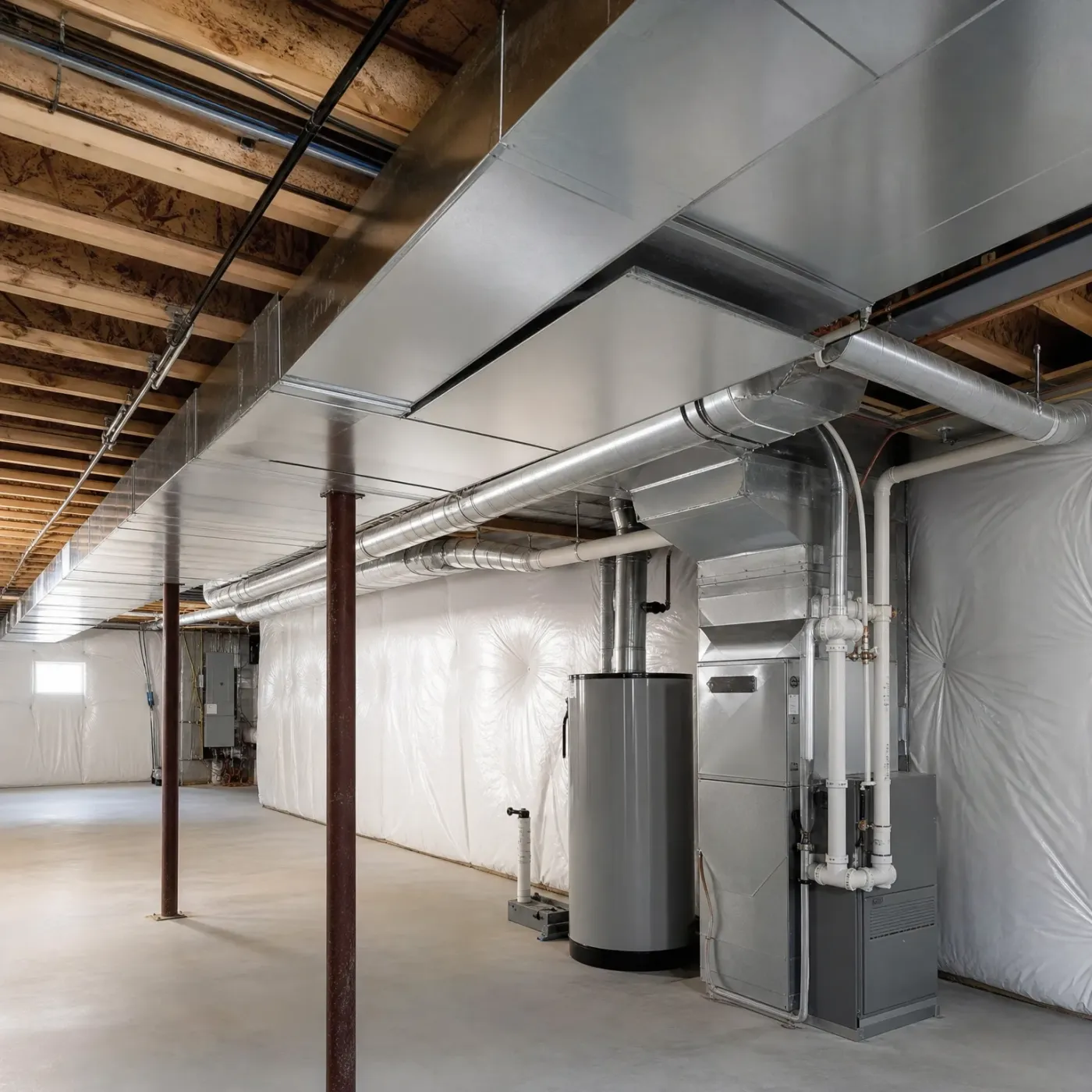
Unfinished basement with concrete floor, plastic-sheeted insulated walls, exposed wood joists, metal support posts, sheet-metal supply ducts, a cylindrical water heater and a furnace with PVC piping.

Get matched with a duct system pro in New York County

Skip calling around for someone who cleans ducts.

Get matched with someone who does this kind of work in New York County.

Connect with a pro

No fee to send it, and nothing to sign.

Why does duct dust matter more in a building this old?

  • Half the homes here were built by 1951

    Half the homes in New York County went up in 1951 or earlier. Older duct runs have had decades to collect dust, and a lot of them were never cleaned once.

  • Heat runs October through April

    Heat runs here from October through April, about seven months. That's seven months of dust and dander getting pushed through the same vents, day after day.

  • Cooling runs June through September

    Cooling runs June through September. Switching between the two systems twice a year stirs up whatever settled in the ducts since the last changeover.

ACS 2020-2024 · NOAA nClimDiv 1991-2020

Empty basement room with bare concrete walls and floor, and an exposed wood-joist ceiling carrying sheet-metal ductwork, insulated pipes, and recessed lights.

Ducts moving air the way they should

This is what a clean run looks like: metal trunk and branch lines open and clear between the joists. Air moves through without dragging a dust load along the way, so less of it ends up back in the apartment through the vents.

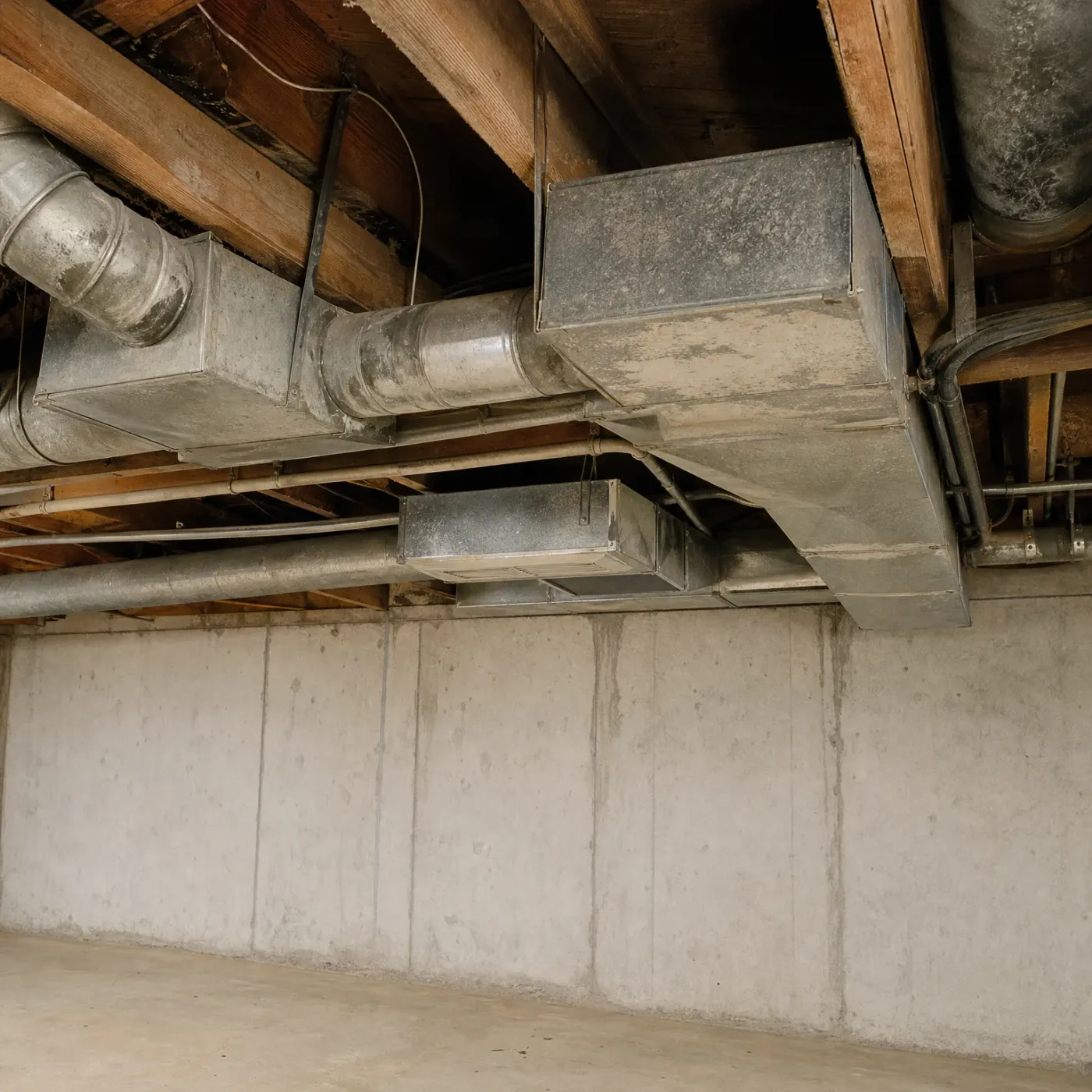
Basement ceiling with galvanized sheet metal ductwork, round pipes and rectangular plenums running between wooden joists above a bare concrete foundation wall and floor.

Ducts carrying more than air

Same kind of basement, same metal ductwork, but years of dust have built up inside the trunk and branch lines. The blower still pushes air through fine. It's what's riding along with that air, into every room, that's the problem.

Do Your Ducts Need Cleaning

Clean and worth leaving alone

  • Vent covers stay mostly free of dust for a few weeks after wiping them down instead of getting a film back in days.
  • No musty smell when the heat or AC first kicks on, just the usual smell of warm or cool air moving.
  • Airflow feels about the same at every vent in the apartment, not noticeably weaker in one or two rooms.
  • No one in the apartment is sneezing more at home than they are anywhere else.
  • You can't recall the ducts ever being cleaned, but there's also no sign of dust, must, or uneven airflow to chase down.

Worth having looked at

  • Vent covers go from clean to dusty again within a week or two, even right after wiping them down.
  • A musty smell shows up specifically when the air handler turns on, not at other times.
  • Dust settles fast on windowsills and furniture, especially in rooms the supply vents feed directly.
  • Airflow is noticeably weaker at certain vents, which can mean dust or debris is blocking the run.
  • Someone in the apartment is sneezing or congested more at home than elsewhere, with no other explanation like a leak or a dying air conditioner.
  1. Dust and dander settle inside the trunk and branch lines over time

  2. The blower stirs that dust loose every time it kicks on

  3. Supply vents carry the dust straight into each room

  4. A technician opens the ducts and vacuums the loosened dust out

Empty basement with bare concrete walls and floor, with galvanized sheet-metal HVAC ducts, a round duct elbow, and pipes running along the wooden joists of the ceiling.
Before you get your ductwork cleaning
An empty unfinished basement with concrete floor and walls, exposed wood joists, steel beams and support posts, galvanized ductwork and pipes, and a single bare bulb light.
After you get your ductwork cleaning

You keep managing the dust and the smell on your own: wiping vent covers, running an air purifier, swapping the filter early. It takes up a bit of your week, every week, and none of it reaches the dust sitting inside the ducts.

You get matched with a contractor who looks at your duct system and cleans out what's built up inside it. No more calling around for quotes or explaining the same problem to the next person on the list. Just one call that goes somewhere.

Power here costs 36.97 cents per kilowatt-hour

At 36.97 cents per kilowatt-hour, running the blower more than it needs to shows up on the bill fast. A clogged, dusty duct run makes the system push harder and longer to move the same air, and in Manhattan that extra runtime costs more than almost anywhere else in the country.

EIA-861 2025

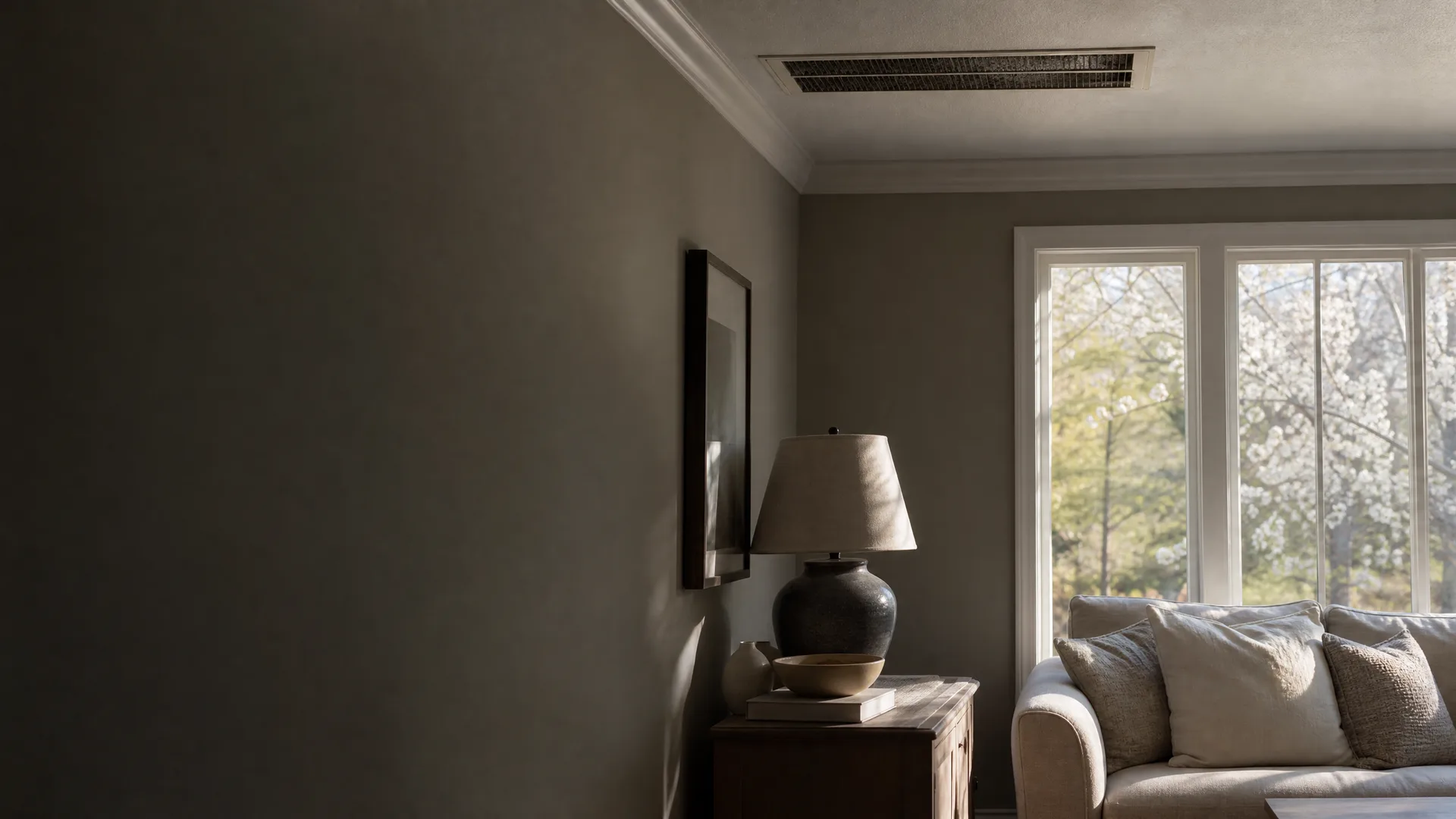
A dimly lit living room corner with a gray wall, framed picture, a table lamp on a wooden side table, a beige sofa with pillows, a ceiling vent, and windows showing flowering trees outside.

Late March, late morning, sun coming in flat across the living room. The ceiling vent grille over the couch has a gray film along its slats, thick enough now that it shows up in the light even from across the room. On the side table under it, the same dust has settled on the lamp shade and along the top edge of a picture frame, a fine coat that wasn't there a few days ago. The heat clicked on earlier for a last cold snap, and that's likely when this batch landed. Nobody's touched the grille in weeks. It just keeps collecting, vent after vent, the same way, all through the apartment.


A woman in a cream sweater and jeans stands in an open black front door of a white stucco house, viewed over the shoulder of a man in a navy jacket in the foreground.

So that's what you're looking at

Dust back on the vent covers within days, a musty smell when the system kicks on, more sneezing than usual when the heat or AC first runs. Any one of those points to the ducts. In a lot of apartments in this county, built before 1951, the ducts have been carrying that same dust for years without anyone opening them up.

You don't have to figure out on your own whether this is the ducts or something else, or spend your evenings calling around and explaining the vent covers and the smell to three different companies. Once you answer a few questions about what you're seeing, you get matched with a contractor who takes it from there and reaches out to you directly.

Interior corner of a room with a dark upholstered sofa and textured cushion, a potted plant, sheer curtains at a multi-pane window showing blurred green and yellow trees, and a dark table holding a wooden tray with stacked coasters and a small ceramic vase.
A single-story white stucco house with dark roof, stone-clad entry tower and three dark garage doors, lit from within at dusk, with a curved concrete driveway and dark mulch beds with boulders and bare young trees in the foreground under an orange and blue sunset sky.

Ductwork Cleaning

Find a duct system cleaning pro in New York County

Duct and vent cleaningDucts or ventsNew York County, NY
Step 1 of 2

What ZIP code is the job in?

  • A beige upholstered armchair with a cushion and knit throw sits beside a double-hung window with a woven shade, next to a white fireplace mantel with a lit fire, a vase of greenery, and a round wooden table in the foreground.
    • Get matched with a pro who works on ducts in New York County.
    • Your duct cleaning request goes to a local pro who does this work.
  • A shallow speckled beige ceramic bowl holding a leafy green branch sits on a wooden dresser beside a tall matte stoneware vase, with a window at left and a dark-framed picture at right.
    • Send it once and finding someone is no longer on you.
    • Send the form and finding a duct cleaner is handled.
  • A ceramic table lamp with a pale tapered fabric shade sits on a rustic wooden table beside a wooden bowl, with a framed artwork on the beige wall and sunlight from a window at left.
    • Answer a few questions instead of calling shop after shop.
    • Describe your ductwork job once, to one pro.
  • A black box-shaped outdoor wall lantern with seeded glass panels and a lit filament bulb mounted on a light gray board-and-batten exterior wall, beside a dark-framed glass door, with green leafy shrubs in the foreground.
    • The pro who gets in touch is licensed in New York and works in New York County.
    • A licensed pro who works in New York County gets your request.