Mini Split Installation in Spring Valley, NY
A new system here will heat from October through May and cool from June through August every year. Tell us about the house, and a licensed contractor who covers Rockland County will get in touch.
Tell us about the job
It takes about a minute.
What Spring Valley winters and summers ask of a mini-split
Homes here need heat from October through May and cooling from June through August, so a mini-split is doing something for you 11 months a year. Winter nights average 23°F through December, January and February, and a heat pump has to keep pulling warmth out of air that cold, night after night, for three straight months.
Summer afternoons average 82°F, lighter work by comparison, but the same unit has to handle both jobs well, not just one. Any mini-split installed new now has to meet the federal minimum of 14.3 SEER2 for cooling and 7.5 HSPF2 for heating. In a climate that leans this hard on heating, how well a unit performs above that minimum on the coldest nights is worth asking about.
- 8 months
- October through May, your system heats
- 3 months
- June through August, it cools
- 23°F
- the average winter night it heats against
- 82°F
- the average summer afternoon it cools against
NOAA nClimDiv, 1991–2020 normals
- Is a mini split worth it?
- For most homes here, yes, especially if a room or addition never gets comfortable off the main system. Mini splits heat and cool the same space without ducts, so they work well for a converted garage, a sunroom, or a bedroom over an unheated garage. With winter lows here averaging 23°F, look for a cold-climate mini split rated to keep producing heat at those temperatures. A contractor can tell you whether one covers your whole heating and cooling need or just fills a gap the main system leaves.
- How many rooms can a mini split cover?
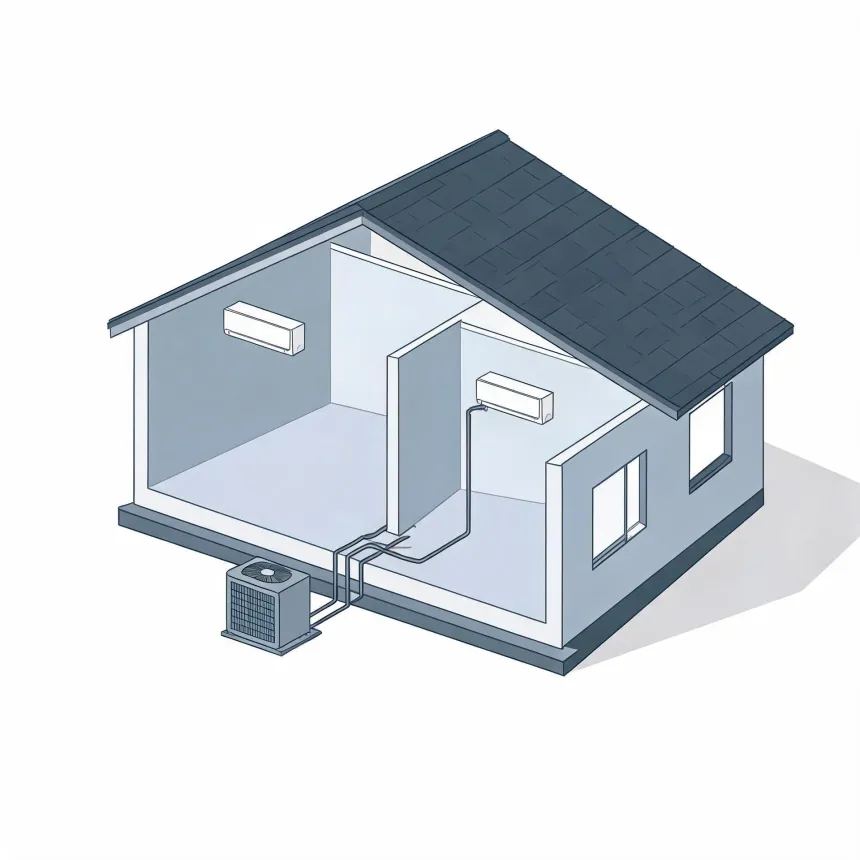
- A single indoor head is sized for one room or open area. If you need several rooms covered, a multi-zone system runs more than one indoor head off a single outdoor unit, each with its own thermostat. How many rooms one outdoor unit can handle depends on the size and layout of those rooms, which is why a contractor sizes the system to the house rather than the room count alone.
- Can a mini split heat a whole house?
- It can, if there are enough indoor heads placed to cover every room, but that takes real planning since homes here need heat from October through May. A single mini split with one or two heads usually is not enough for a whole house at 23°F winter lows. Whole-house coverage means either a multi-zone system sized room by room or pairing the mini split with the existing furnace for the coldest stretches. A contractor can walk the house and say which approach actually keeps every room warm.